

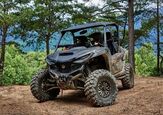
The Wolverine RMAX Series Sharpened Its Teeth for 2025
Yamaha Shows Off the 2025 RMAX Lineup Under the Arizona Sun
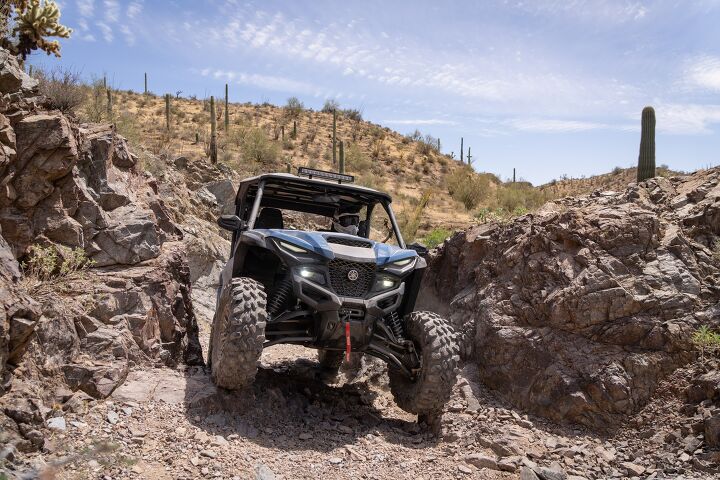
Yamaha’s RMAX is a staple in the recreational UTV market. Since its launch in 2020, the largest of the Wolverine models has undergone a few minor changes. However, for 2025, Yamaha ensured not to hold back, introducing significant updates to the series, including the all-new RMAX4 1000 Compact R-Spec, a four-seat model designed with a shorter wheelbase and refined suspension, making it ideal for tight trails and enhanced handling. This new addition brought forth the Compact as an option, while the full-size RMAX4 1000 was expanded to provide more rear legroom and increased comfort.
Support the brands that support us. Get 10% off any Cardo product with promo code ATV10. Just hit the link here: https://cardosystems.rfrl.co/yyx8y
This transformation converted the 2024 RMAX4 into the 2025 RMAX4 1000 Compact and introduced the new and improved RMAX4 1000 (not to be confused…). With so much evolution occurring in such a short period of time, Yamaha thought it advantageous to invite a few of us to Florence, Arizona, so we could explore the 2025 RMAX features ourselves and possibly anticipate what both new and returning RMAX customers might think of the BluCru’s revamp of their beloved lineup.
The manufacturer stated that the goal behind this RMAX facelift was to maximize comfort and enhance the automotive appeal while delivering some long-requested features on this sport-utility machine. They extended the wheelbase for added legroom in the back, incorporated a sleek new display, and fine-tuned the suspension. As the current star in Yamaha’s UTV cluster, expectations remain as high as ever for what this legendary brand could create for its most significant RMAX offering.


For RMAX owners who primarily do duty on gentle surfaces, an unlocking rear differential and updated front suspension have added a “Turf Mode” in selectable options, promising to do less damage to the ground under your tires. It lets the rear wheels spin more freely, making tight turns easier and tearing up less turf. In addition to Turf Mode, the new differentials make engaging and disengaging the diff lock much simpler than older models. Instead of being stuck crawling at 6 km/h to engage the diff lock, now you can switch it on the fly at much more comfortable approach speeds as you roll up to a hill or gnarly section.
These changes to the differential were immediately apparent on our day of riding. The RMAX has always felt like a machine where you can point the nose at a problem and throttle through, especially when it comes to climbing—and the new RMAX holds up to that reputation well. Our ride outside Florence took us through plenty of hills and washes, with rock climbing in between, where engaging the diff lock on approach to a wall saved some time compared to the 2024 model. The new suspension setup also hits different—way more planted and plusher when bouncing through rocks and ruts.

Also new for the 2025 model year, the RMAX has undergone a suspension overhaul. While on the spec sheet, things may look familiar, with FOX 2.0 shocks across the lineup, factory tuning has been updated, as well as sway bars. While the result frankly still feels like an RMAX, new changes were made to promise greater comfort and stability at speed. For the R spec and XTR models, FOX 2.0 QS3 shocks with quick three-position adjusters come standard, letting you switch up damping with minimal effort. The Sport model opts for 2.0 DSC units, which let you fine-tune both low- and high-speed compression but require a bit more effort for adjustments.
The factory tuning on these DSC shocks is two clicks out on the 25-click low-speed and 26-click high-speed compression adjusters, giving you a wide tuning range right out of the gate. The top-of-the-line model, the RMAX Limited, offers the FOX 2.0 IQS shocks that offer electronic in-cab adjustment via a switch, perfect for tweaking your setup without stepping out of the vehicle.

Paired with this newfound comfort in suspension, Yamaha has made the RMAX's brakes grabbier and more efficient. For 2025, they threw in a totally new brake setup—refreshed calipers, improved pads, new brake lines, and even beefed-up knuckles—so you get stronger stopping power, smoother pedal feel, and far less noise. Quieter pads work alongside a bigger caliper and piston to provide more reliable braking with less audible feedback.
They also teamed up with Hayes Brakes to slap on their Sovren Calipers, which are all about delivering more bite without the usual squeal. While it’s hard to say these new brakes are more effective than the outgoing model, they were certainly confidence-inspiring after a few quick stabs at the pedal, especially for steeper downhill stretches where the engine braking from the CVT wasn’t quite enough for a steady descent.
Though not new for 2025, the Yamaha D-mode system still shines in the RMAX, especially in the rock-crawling desert washes where we could test these models. You get three throttle modes—Sport, Trail, and Crawl—and swapping between them mid-ride is as easy as twisting a knob. Each one dials in your power just right for the terrain.

Being able to fine-tune your throttle response between three programmed modes with a quick turn of the dial is wonderful when you clear a rock wall and want to get your foot down a bit more in the following wash. Like previous years, the D mode always allows access to the full output of the RMAX’s engine, just changing the response curve to the pedal for finer adjustments that suit your current environment. For much of our ride, I left the selector in Crawl mode and used more right foot pressure on the faster sections of the trail.
Similar in experience to the D-mode system, the updated electronic power steering for 2025 offers a solid 62.5% boost in power and an extra 12% torque to back it up to help you out when the trail gets sketchy. Yamaha now allows you to switch between three steering modes—High, Standard, and Low—right from a dash-mounted switch, which is clutch when you're bouncing between tight trails and wide-open sections.
While EPS systems can be the bane of many drivers’ experiences, the unit in the RMAX offers several levels of feedback, all adjustable via a switch in the cabin. Plus, having a smooth, responsive feel to the inputs. Yamaha’s point of minimizing negative feedback without losing awareness certainly feels met by this new EPS system, where rocks and other obstacles give just enough pushback to make you aware of them without jolting the wheel in your hands.

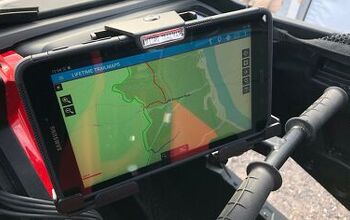
The Adventure Pro system is another part of the RMAX that has seen extensive updates. It boots up much faster now, so no more sitting around waiting at the start of your ride, and the new 7-inch screen has been updated to look far more automotive and feel more premium than the outgoing system. The touchscreen is now more responsive, with improved resolution and brightness for better visibility in sunlight.
GPS files can also be easily shared- anything in a .GPX format can be uploaded via USB to the system and tracked on the screen. You can also record and save your rides directly on the device, making sharing routes or analyzing performance easier. The UI (user interface) works around customizable “tiles” displaying information from GPS tracks to engine temperature and your music. And thanks to Yamaha’s collaboration with Magellan, the mapping software now includes more off-road-specific features and improved trail data.
An MTX Audio system, which was certainly a strong performer, now comes standard on all RMAX XT-R and Limited models. Able to blast more than enough volume out for audible music over the RMAX’s engine growl, even at high RPMS, it had enough sound quality to make it enjoyable doing so. While true audiophiles are sure to find a long list of notes about the sound quality, for day-to-day use and fun adventure riding, there is plenty to provide a soundtrack.

One slight negative to the new Adventure Pro system is a clunky interface for changing volume. It would be a lot easier if you could adjust it right from the home screen or with a quick button press. As it stands, this system is still a massive upgrade from the outgoing edition, and though it is no longer available for aftermarket addition to models that come without it, it’s well worth the additional charge from Yamaha.
The limited trim has an extra addition in a full-color TFT dash display, which is another significant improvement, even over the standard display in the other RMAX models. This new color display adds a more automotive-style vibe to the cockpit, letting you customize layouts and monitor info your way. It’s a solid upgrade that the lower trims just don’t offer.
Perhaps the biggest addition to the RMAX line this year is the 2025 RMAX4 1000, a fresh full-size 4-seater model. Offering four seats in a true full-body style, unlike the compact 4-seater, this new model retains the piston-assist dump bed with a 600-pound capacity and has a notably more spacious interior than the smaller wheelbase models. It’s about 27.5 inches longer than the Compact RMAX4, giving rear passengers more legroom and overall space.

This new, longer model is available in both the limited and XTR trims, and after some time behind the wheel of the limited, I was smitten. The added length didn’t seem to harm the capability of the RMAX, and if it did, it certainly didn’t get the memo. Some faster sections of the trail felt just a bit more planted and confident, with the added length and tighter turns around rocks were nicely facilitated by the accessory rock guards.
Turf Mode also helps here by unlocking the rear diff for a tighter turning radius with less turf damage. If hauling four people is a frequent requirement for your needs, or if you want the capability, the 4-1000 is a fantastic choice and more than holds its own on the trail against the smaller and lighter RMAX options.
The RMAX market segment has long been ideal for someone more focused on exploration and a few utility tasks rather than a raw sport in their UTV. Yamaha's updates for this MY25 refresh may seem minor at first glance, but they reflect a major effort in engineering and a clear response to what RMAX owners have been asking for in their vehicles.


Matthew McNulty is a desert born motorhead, with a thirst for hunting any story from the dirt to pavement and beyond. From getting pelted with rocks at KOH to testing the industry's latest and greatest releases, he's there.
More by Matthew J McNulty





![Pedal Powered Side-by-Side [video]](https://cdn-fastly.atv.com/media/2022/10/24/8744132/pedal-powered-side-by-side-video.jpg?size=350x220)




Comments
Join the conversation